Success story
Sustainability begins with listening
Eight months ago, I arrived in the Philippines as part of a volunteer cooperation assignment with CECI to support its partner organization, PATAMABA, and its Purple Market initiative in developing a sustainability plan. Confident that I would contribute strategic tools, I quickly realized that, before taking any action, I first needed to listen. This experience transformed my understanding of what sustainable development truly means.
At the heart of the informal economy
Founded in 1991, PATAMABA (Pambansang Tagapag-ugnay ng mga Manggagawa sa Bahay) is now one of the largest networks of workers in the informal economy in the Philippines. The organisation has more than 20,000 active members across the country, 98 per cent of whom are women. Whilst the informal economy accounts for nearly 70 per cent of the active workforce in the Philippines, PATAMABA’s members carry out a wide range of essential jobs, including home-based workers, street vendors, service providers, construction workers and small-scale transport operators. Contributing to their communities’ economies on a daily basis, they often work in precarious conditions and with limited access to resources.

To support the economic development of its members, PATAMABA launched the Purple Market initiative in 2020. Much more than a physical and online marketplace, Purple Market is a space for marketing, training and networking that enables women entrepreneurs to develop their skills, promote their products and exchange ideas with other women facing similar realities. The products sold through Purple Market are created by home-based workers and small-scale women entrepreneurs from different regions of the Philippines, showcasing local craftsmanship while promoting women's economic independence. The products range includes a variety of food items, such as peanut butter, chilli-garlic paste and artisanal vinegar, as well as everyday products such as laundry bags, denim bags and household items.
These women entrepreneurs operate in an environment where resources can be limited, but where solidarity, mutual support and and adaptability are powerful drivers of resilience and development.
Rethinking sustainability based on local realities
As I met with members of the organisation, several questions kept coming to mind: how can we talk about sustainability without imposing an external perspective? How can we support an organisation’s growth without changing what already makes it strong? How can we develop long-term strategic tools without losing sight of the values and identity that are the organisation’s strength?
This reflection transformed the way I approached my assignment.
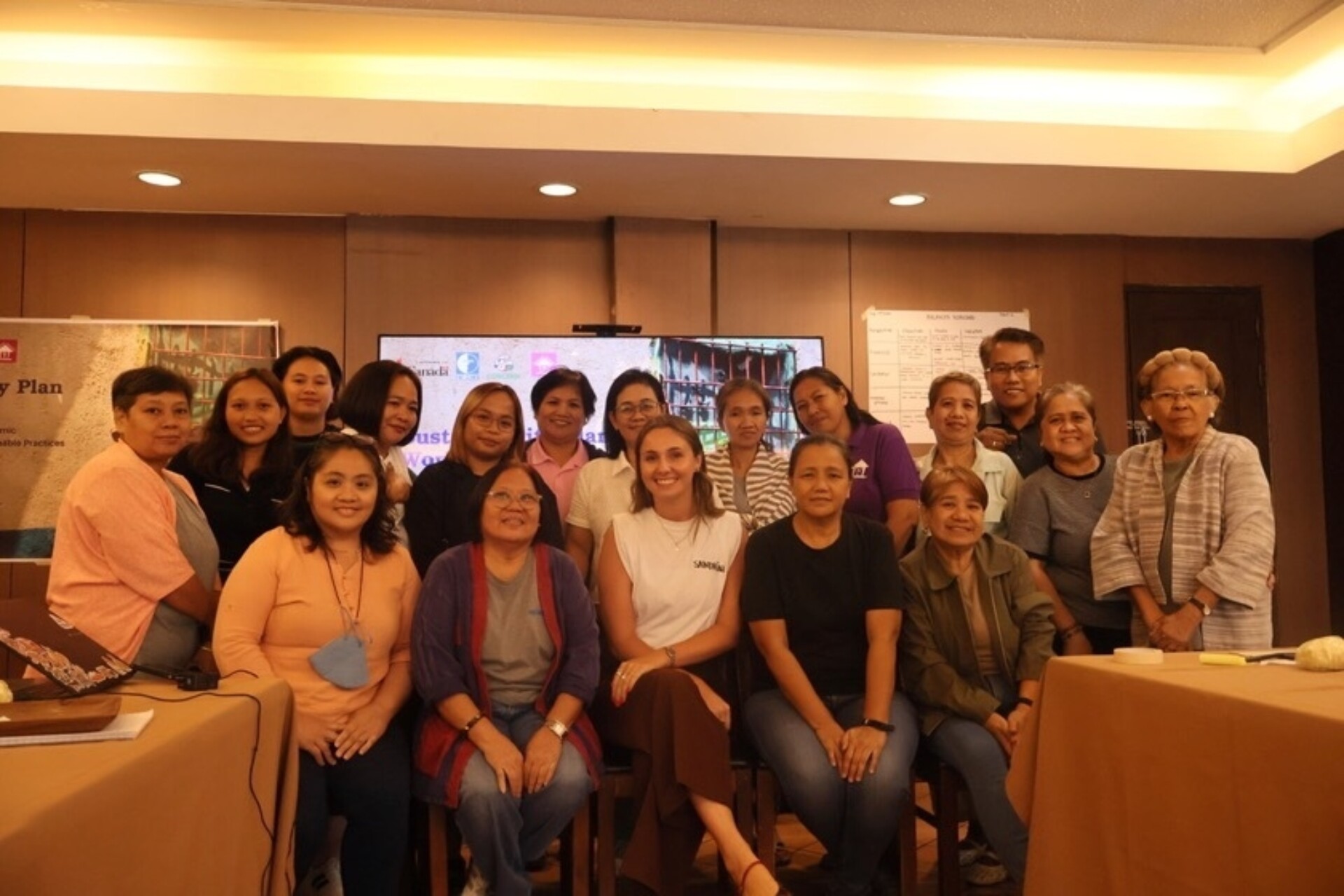
Rather than arriving with predefined solutions, I took the time to listen to their experiences and build the sustainability plan around their perspectives and priorities. As part of this process, I had the pleasure of leading and facilitating a workshop with the Purple Market team and members.
IInitially, the objective was to discuss sustainable development. However, the discussions quickly moved beyond environmental issues. The participants spoke about their day-to-day lives, the challenges they face, but also their ambitions: to provide a better quality of life for their families, to develop their skills, to increase their financial independence and to pass on their expertise to future generations.
By working together on management tools tailored to their context, I realised that sustainability is not built on a one-size-fits-all model, but in collaboration with the people involved. This approach led to the development of a sustainability plan, tailored to the realities of Purple Market, to support the organisation in its planning, monitoring of actions and long-term development vision. Click here to access the sustainabilty plan guide. This approach enabled the Purple Market team to reflect collectively on its priorities, to formulate a shared vision for long-term development, and to equip itself with tools to better plan, monitor and evaluate its actions. This guide aims to strengthen Purple Market’s strategic environmental capacity by providing tools to assess and improve the environmental sustainability of its products. It also helps strengthen the organization’s strategic socio-economic capacity by supporting the diversification of its revenue streams and the implementation of sustainable practices that ensure the long-term viability of its initiatives.
Communities as agents of change
This experience has enabled me to see cooperation as a genuine process of mutual learning, in which each person contributes their expertise, learns from others and helps to develop solutions rooted in local realities.
I am now continuing my work in the Philippines with a renewed conviction: communities already have the answers. By recognising their expertise and working alongside them, it becomes possible to develop relevant, sustainable solutions that are rooted in their reality.
The most lasting changes often begin with a relationship, with listening attentively and recognising those who are already at the heart of the change.
Pursuing a sustainable and collective approach
The development of the sustainability plan represents an important first step for Purple Market in shaping its long-term vision and strengthening the long-term viability of its initiatives. Beyond the document itself, this plan will serve as a roadmap to guide the organisation’s decisions, support the development of new initiatives and ensure that its growth remains aligned with its mission of economic empowerment for women.
Over the coming months, the Purple Market team will use the sustainability plan as a management tool to prioritise its actions, monitor progress and guide the development of new initiatives. This approach will enable the organisation to gradually consolidate its organisational capacities whilst maintaining an approach centred on the needs of its members.
Through this joint initiative, Purple Market continues to act as a catalyst for women’s economic empowerment, strengthening their ability to develop sustainable income-generating activities, increase their financial independence and play an active role in creating a more inclusive and solidarity-based economy. This experience illustrates CECI’s approach to volunteer cooperation: focusing on mutual learning and capacity-building for partner organisations so that they can pursue their own development priorities in a sustainable manner.


Our partners
We would like to thank our financial, consortium, and implementing partners, without whom this project would not be possible. CECI’s Volunteer Cooperation Program is made possible through funding from the Government of Canada provided through Global Affairs Canada.