Blog post
The courage of women like Awa Sow
March 16, 2026In Senegal, in the Matam region, many women are shaping the future of their communities every day through their work and determination. On the occasion of International Women’s Rights Day, it is important to highlight these journeys that demonstrate courage and leadership. Awa Sow is an inspiring example.
A journey shaped by perseverance
Married for more than twenty years, Awa has built her life with dignity and perseverance. After a schooling path limited to basic literacy, she became a seamstress. For many years, sewing was her main source of income. She knitted sheets and made personalized fabrics for women in her community.
Driven by the desire to diversify her activities, Awa also set up a small home garden where she grows eggplant. Her income mainly allowed her to cover the essential needs of her household and support the children in her care. Savings remained limited, opportunities to expand her activities were scarce, and her confidence to assert herself in decision-making spaces was still fragile
A turning point with the SAGA 2 project
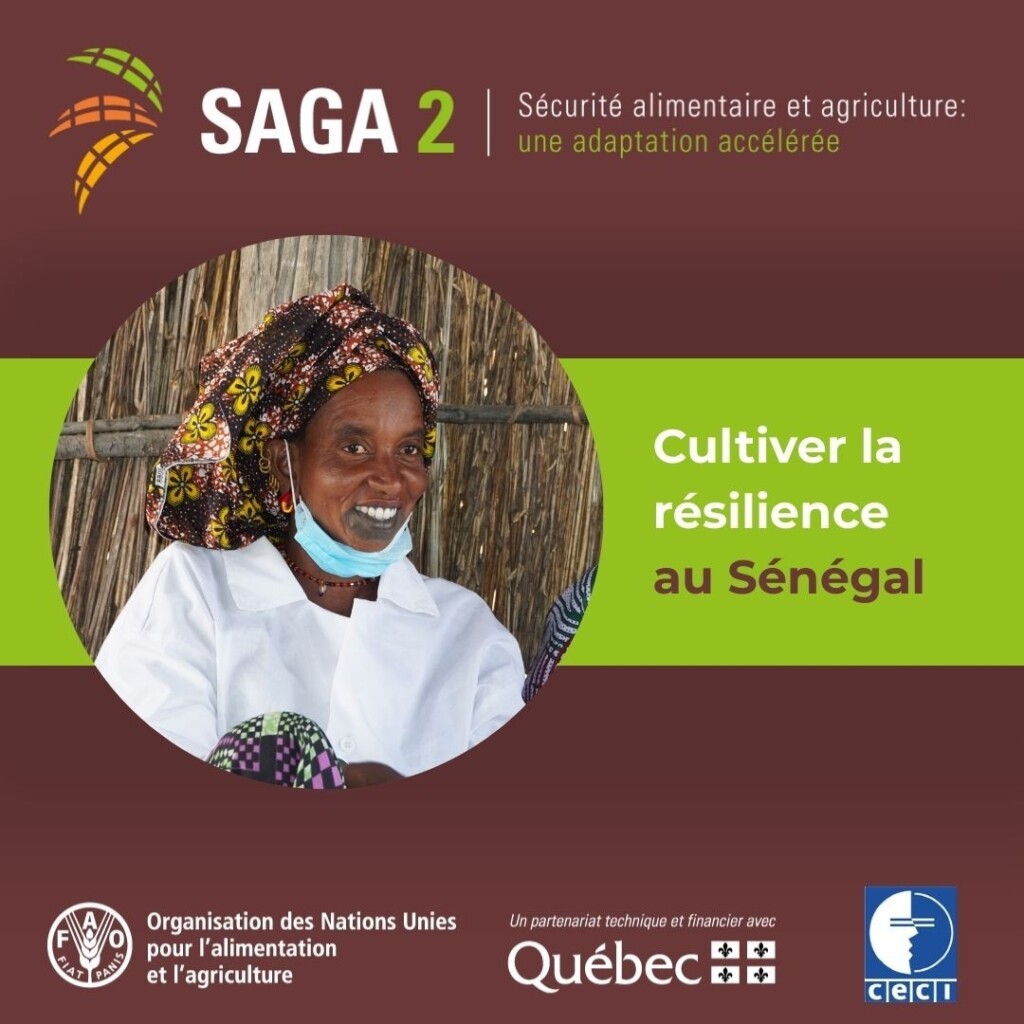
It is in this context that the SAGA 2 project : Food Security and Agriculture: Accelerating Adaptation takes place. The project is coordinated by the Food and Agriculture Organization of the United Nations (FAO), with technical and financial support from the Government of Quebec. In the village of Mbam, in the Matam region, CECI implements the Integrated Resilience Gardens initiative. Through this initiative, women strengthen their knowledge, gain access to market gardening plots, and develop practical solutions to consolidate their economic autonomy and adapt to the impacts of climate change.
For Awa Sow, this initiative marks a turning point. She receives a plot within a market gardening perimeter and takes part in several training sessions: leadership and personal development, seed identification and management, circular economy, improved cookstove production, and the installation and maintenance of solar panels. These learnings go far beyond agricultural techniques. They open up broader reflections on climate challenges, sustainable resource management, and the central role women play in the economic and social life of their communities.
Concrete changes for Awa and her community
Today, the changes are tangible. Her market gardening activities generate additional income and contribute to healthy, abundant, and diverse food for her family. Vegetables that were once purchased at the market are now grown locally. Awa can now save money, respond to unexpected expenses, and develop a small complementary business. She hopes to continue expanding her activities in order to save enough to purchase a sewing machine. This investment would allow her to reduce production time, strengthen her economic autonomy, and create more time for herself. But Awa’s courage goes beyond the economic dimension.
Leadership training has strengthened her confidence. She now participates more actively in decision-making and speaks with greater assurance in public discussions. She also notes that her freedom of movement has expanded since she began contributing more to household expenses. The solar energy training is a particular source of pride. Alongside other women, she helped install the solar system that powers the home of the village chief. They also carry out repairs in nearby hamlets where solar systems support the market gardening perimeters, a field traditionally dominated by men.
Through their knowledge of seeds and biochar, Awa and other women also contribute to improving soil fertility and supporting the long-term health of agricultural lands.
In a locality where public services remain limited, the SAGA 2 initiative opens spaces for learning, collaboration, and action for women in the community.
Awa Sow’s journey reflects the courage of women : a courage shaped by work, perseverance, learning, and commitment.
Through her story, a message resonates throughout the month of March and during this International Year of Women Farmers: when women have spaces to learn, build, and lead, they shape lasting transformations for themselves, their families, and their communities.
Our partners